
AI and OCR Technology: How Text Extraction is Changing the Future of Education
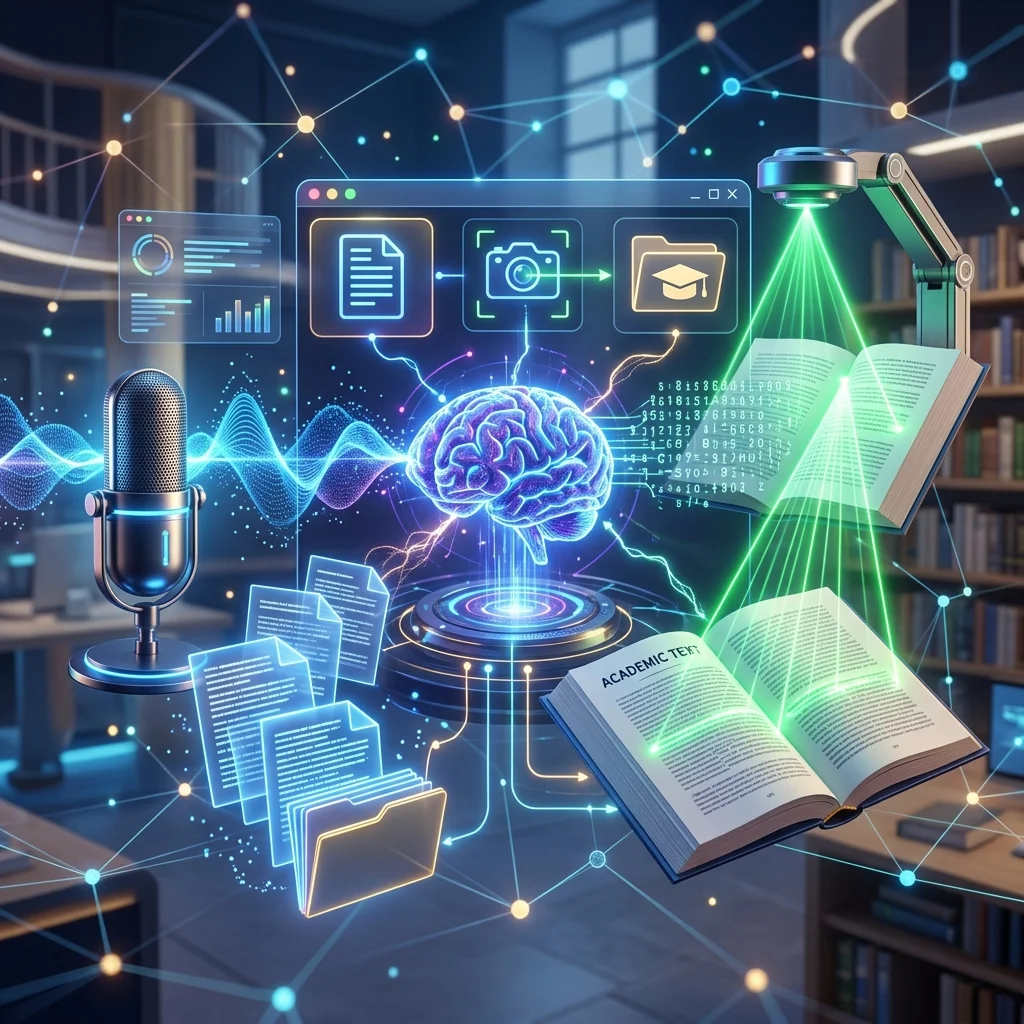
Imagine if you could convert a picture of a whiteboard filled with complex notes, or a page from an old reference book, into searchable and editable digital text in mere seconds. What seemed like magic or science fiction just a few years ago has today become a tangible reality thanks to two revolutionary technologies: Artificial Intelligence (AI) and Optical Character Recognition (OCR).
In this guide, we will dive deep into these technologies and explore how the modern student can use them to double their educational productivity and save thousands of hours that used to be wasted on "manual transcription" of lectures, books, and paper research.
🔍 What is OCR Technology and How Has it Evolved Smartly?

Optical Character Recognition (OCR) is the process of converting images containing text (printed, handwritten, or photographed with a mobile phone) into digital text data that a computer can process and search within.
Previously, this technology was quite primitive and failed to recognize the Arabic language due to the complexities of connected letters and diacritics. But with the introduction of Artificial Intelligence and Deep Learning, OCR has become Capable of understanding the context of words, recognizing different handwritings, and even predicting missing words with an accuracy that sometimes exceeds human senses.
🚀 The Benefits of OCR for University Students: A Revolution in Efficiency
Why is this technology considered an indispensable necessity in every student's bag today?
1- Smart Lecture Transcription
Photograph presentation slides or the whiteboard during the lecture, and instead of manually rewriting them at home, use an OCR tool to convert them into text. You can then merge them with your own notes or search them for keywords for quick quizzes.
2- Digitizing Valuable Paper Books and References
In major university libraries, you might find a rare reference that is not allowed to be borrowed. Instead of photographing it as an image (which prevents you from editing or searching the text), scan it and convert it to a text-based PDF. This will enable you to quote directly in your research without spelling errors.
3- Organizing Handwritten Notes (Digitization)
If you prefer writing by hand on paper, you can photograph your notes and convert them into digital text. This not only protects them from getting lost but also makes them shareable with your colleagues in a professional and organized manner.
Try extracting text from an image now for free
Use our free and smart tools to save your time and academic effort.
🇸🇦 The Challenges of the Arabic Language and AI: How Were Complex Texts Tamed?
The Arabic language is considered one of the most difficult languages for OCR engines due to its "connected" nature. Modern engines, like the ones we use in Adawati, rely on models trained on millions of Arabic documents, ensuring extremely high accuracy through:
- Word-based recognition: Understanding the word as a whole based on the sentence's context.
- Automatic error correction: Detecting and correcting typos based on linguistic probabilities.
- Support for traditional fonts: Supporting various Arabic fonts (from Khedivi to Naskh to Ruq'ah).
📊 Comparison: Manual Transcription vs Using AI OCR
Let's look at the numbers to understand the magnitude of time and effort saved: | Task | Manual Transcription | Using an OCR Tool | Savings Percentage | | :--- | :--- | :--- | :--- | | Book page (300 words) | 10 - 15 minutes | 5 seconds | 99% | | Full lecture (10 slides) | 60 minutes | 2 minutes | 96% | | Paper research (20 pages) | 5 hours | 10 minutes | 97% |
These numbers mean that a student using this technology spends their time on comprehension and analysis instead of typing and copying.
🛠️ The Future of Education: What Will Learning Look Like in 2030?
We are gradually transitioning towards a paperless classroom environment. Technology is the bridge that carries our past contents into the digital future:
- Augmented Reality (AR): Pointing your smart glasses at a page in a book to see a visual explanation appearing instantly above the extracted words.
- The Smart Library: Converting all central library books into globally searchable texts, making scientific research astonishingly easier.
- Instant Translation and Summarization: Extracting the text, translating it, and summarizing it in one step thanks to integrated AI.
🌟 Why Choose "Adawati" to Extract Your Texts?
At Adawati, we have invested in the latest AI-powered cloud OCR technologies to provide the Arab student with the best possible text extraction experience. Our tool features:
- Superior accuracy in Arabic: Full support for all characteristics of Arabic calligraphy.
- Speed and ease: Instant results even for high-resolution images, with a very simple interface.
- Complete privacy: Your images and files are processed completely securely and deleted immediately upon process completion.
- Free of charge: Believing in the necessity of providing these technologies to every ambitious student without financial barriers.
Start digitizing your academic life today, and make technology your companion that saves you time and effort so you can dedicate yourself to creativity and innovation in your major.